08 November 2005

Bread Update part II


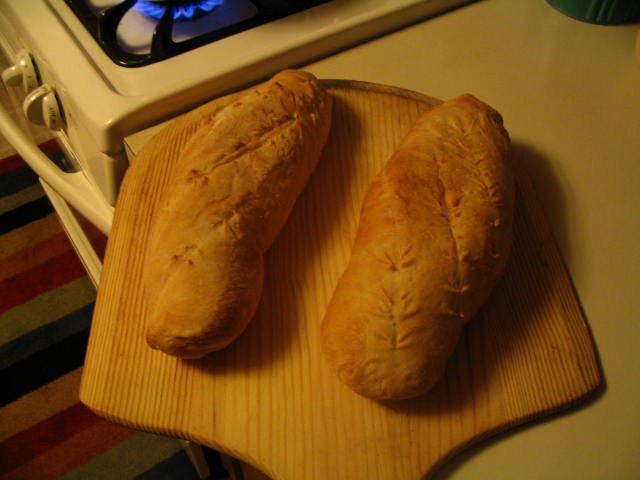
I promised a picture of the bread from last weekend, here it is.

Caution Church Ahead


Several months ago I sent this picture to Popping Culture and he put it on the blog. But I lost the picture when I spilled a Rolling Rock on my laptop (the ibook survived!). I offer this picture as the icon for the current and next generations of the Christianity.

Last year the Christian Century ran a feature on The Emerging Church and Brian MaClaren. A year later the term emerging church popped up again and I went back and reread the Xian Century article and then went to the Andover Newton library and checked out all the books I could on the subject; there I found some voices, thoughts, ideas and ventures right on track with my own.

I went to Colgate Rochester Divinity School and proudly graduated with honors and with all of the regalia of a Liberal Protestant degree. But after five years of ministry I found some cognitive dissonance (a term I learned at CRDS) between the education I received and the community I serve. My hunch is that all seminarians experience this.

What I am seeking is a way of pastoring that blends the Appalachian love of preaching, emotion, the bible and fellowship with the Northeastern love of reason, liturgy, and the spoken word. Can one properly blend Billy Sunday and Peter Gomes? I think so.

Prostestantism in North America somehow has to find a way to get beyond the liberal vs. fundamentalist fights, those fights do not interest me in the slighest - they bore and suck the life out of me. Those fight draw you to them and use all of your creative energy. Uggh!

I am seeking a Christianity that is somehow beyond that gulf and appreciates the values of both sides (minus the political wrangling). I am seeking a Protestantism that still protests an infallible human figure, a "priestly class" and non-democratic bureaucracy. However, I am seeking a Protestantism that fully embraces and draws from the creative wellsprings of contemplative prayer, spiritual disciplines, historic connectivity, and observance of the Christian year. I am seeking a Baptist path that uplifts a Christ-ocentric narrative, an unabashed emotive faith expressions, a love of terribly beautiful "banged out" hymns, radical discipleship and holds supreme the voluntary principle. However, I want to be connected to the Anglican bloodlines that run through this path. I like to wear a clerical collar, bless people, and hear confession.

All of my trains of thoughts keep hitting both centrally and tangetially to some of the aveunes of the Emergent Church. I am bit hesitant to jump on board. Why? I refuse to bleach my hair, give up business suits, and create a church that is geared more to one specific generation. I cherish the memories of sitting next to Grandma in church. I cherish the intergenerational aspect of congregational worship. I cherish the wisdom, folly and joy when there are blue haired old ladies, no haired men, thin haired babies and thick haired teenagers.

These are embryonic thoughts. I will continue to read, think and write this out. Comments will be greatly appreciated. Still be forewarned: CAUTION CHURCH AHEAD.
07 November 2005

Counting Abner

We counted you in our hearts.

Expectancy. Memory. Brokenness.

Count Your Dead

Yesterday the church I served observed All Saints Day. As part of the liturgy we honored the departed. During one of the prayers I invited folk to speak the name(s) of the departed that were on their lips. To my surprise several voiced a name, some couldn't.

I meant to read this poem as part of the liturgy, but forgot. It is a poem(s) by C. D. Wright, a prof at Brown. This is from Stealing Away: Selected and New Poems.

Count your fingers
Count your toes
Count your nose holes
Count your blessings
Count your stars (lucky or not)
Count your loose change
Count the miles to the state line
Count cars at the crossing
Count the ticks you pulled off the dog
Count your shells
Count the points on the antlers
Count the newjacks's keys
Count the beds you've got to let
County your cards; cut them again

Count your gray hairs
Count your chigger bites
Count your pills
Count the times the phone rings
Count your T cells
Count the days sine your last menses
Count the storm candles
Count your stitches
Count your broken bones
Count the flies you killed before noon

Count your folding money
Count the times you said you wouldn't go back
County your debts
Count the roaches when the light comes on
Count your kids after the housefire
Count your cousins on your mother's side
Count your worrisome moles
Count your dead:

Count the days of summer ahead
Count the years you finished in school
Count the jobs you don't qualify to hold
Count the smokes you've got left
Count the friends you;'ve got on the inside
Count the ones who've already fallen

06 November 2005

Open House Weekend

Thanks for moseying over to see what theobilly is all about. Feel free to nose around, poke your head in, listen in on conversations. Be sure and sign the guestbook, snack on some cheese and crackers and take with you a thank you gift before you leave. Over the next few days there will be some cosemtic changes along with posts.

04 November 2005

The A.P. Carter Theory of Ministry

If you were able to watch the PBS special on the Carter Family you saw A.P. Carter roaming the hills of Appalachia searching for all types of Scots-Irish traditional songs, hymns, mountain tunes, and what not. He collected them then produced them. He took in all of these songs and sifted them through his creative mind and produced a Carter Family product. When we all sing Will the Circle Be Unbroken, we sing it the way AP Carter produced it. I wonder if there is an individual alive who remembers in its true "mountain form?"

So the same goes for ministry. As pastors we roam hospital rooms, living rooms, baptismal waters, Books of Common Prayer, ancient contemplative works, coffee shops, donut houses, jazz clubs and the like. We take all of this stuff in and sift it through our creative Spirit and produce a form of ministry, a new creation.


03 November 2005

The Joe Morgan Theory of Ministry

Growing up in West Virginia my baseball heart always called Cincinatti home. How many hours did my ears soak up the voice of Joe Nuxhall and Marty Brennaman? How many times did I dream I would rise from my catching crouch and throw out a runner attempting to steal second jus like Johnny Bench? How many times did I hear Joe Morgan simply say: "See the ball, hit the ball." That phrase from Joe Morgan stuck with me. I used it as my theology of ministry as I left seminary. But I didnt really grasp it till the other day. In ministry you dont try to pull an outside pitch into left field, you hit a ball down the line into right field. You see the ball and hit the ball.

The other day the church I served changed the times we worship and offer Sunday School. After this change we noticed that we lost several kids but gained a whole bunch of adults. I cringed at the sight of empty child classrooms and frustrated teachers but delighted in the overflowing room of adults. My natural inclination was to force the issue and get the kids back (aka trying to pull and outside pitch). But I saw the ball (a room full of adults) and hit the ball (prepared the best bible study I could.)

Last Sunday the new Sunday School superintendent went around and asked adults to teach classes and asked kids to commit to Sunday School. (Sometimes you have to pull an outside pitch to move the runner or score a run) As always, every metaphor has its limits. But overall I still think the see the ball hit the ball approach works at least 68% of the time.

02 November 2005

Let Us Now Praise the Spoken Word

This afternoon while riding back from the VA home of RI I listened to portions of the Rosa Parks service. If you heard Sen. Barack Obama of Ill. or Gov. Jennifer Granholm of Michigan, you now know the power of the spoken word, the need for the spoken word and the heightened communicative form of the spoken word. The Church desperately needs more preachers of the spoken word, preachers who take their sentence structures, natural rhythms, and word selection serious. If we take our time, chew on thoughts, let sentences stew without a barrage of to be verbs, ears on Sunday morning will perk up, take notice and appreciate a fine sentence. Too many areas of life suffer from a depletion of valueless words, sermons should not "be" another dead end vocabularly street.

The Perfect Bowl of Oats

As the sun begins her journey farther and farther away from us my stomach initiates the craving for oats process. After three years of oating I offer this as the perfect bowl of oats.

Serving for one:
1/2 cup of oats, preferably organic and not quick. Believe it or not, Whole Foods Organic Oats in the bulk section cost less the Quaker Oats -- no foolin'.
1 cup of water, preferably filtered with a Brita or the likes filter.
Bring water to a boil, add a pinch of salt.
Dump oats in the water, let boil for about five seconds.
Turn heat down so that the oats simmer.
Go take a shower, read the paper, whatever you do.
Come back in about 15 minutes (when "eyes" have formed, just like rice)
turn off heat, put lid on pot.
Prepare your bowl with dried fruit (cranberries, raisins or fresh fall apples)
Pour in cooked oats and a splash of milk.
Venture off with a couple pieces of toast, a cup of oragne juice, a cup of coffee and you are in breakfast heaven.

This early morning meal will stay with you through the morning, preventing cravings, and will make you quite regular.

enjoy

The Day After All Saints Day

Yesterday a good portion of Christendom celebrated All Saints Day, the branch I belong to (for the most part) let it pass without any fanfare or excitement. But I have always been drawn to All Saints Day and more particularly to the Lives of Saints. I toyed with the idea of naming our first child Saint, that way the child would always be a saint; the wife didnt go for that.

In Seven Storey Mountain, Thomas Merton resolved to live the life of a saint. I always admired his determination.

One day I found myself reading a book of prayers by Karl Rahner, one was addressed to St. Thomas Aquinas. I prayed the prayer without ever realizing what I was doing. It was great prayer. Prayer to Saint Thomas Aquinas.
So I ask of you, St Thomas, (using the traditional formula, the precise meaning of which I shall not ponder right at the moment): Grant that you will intercede for me with God, insofar as all saints stand for all other saints, among whom even poor sinner like myself belong--grant me your intercession so that even if only from afar I may become a little like you: impartial and sober, with courage to consider well before delivering a fiery speech, a man of the Church but not clerical (my meaning here is doubtless clear to you).
Prayers for a Lifetime